




Imagine a scenario where invoices land at two different suppliers in the same month: one billed to “Meridian Industrial Inc.,” the other to “MERIDIAN INDL INC.” On paper, they seem completely unrelated, each with their own payment history and risk profile. Though they are the same global buyer, neither supplier can see that the other exists. That blind spot has real costs: duplicated collections effort, inconsistent credit terms, and risk signals that never connect across the two accounts.
These scenarios are not as uncommon as they might seem. Resolving them starts with seeing a buyer the way its entire network already does.
What’s under the lake
Most credit and collections decisions rely on a company’s internal accounts receivable history. That view alone, however, cannot show how a buyer behaves across the rest of the market. This leaves cash flow forecasts inherently unreliable. And the stakes to be reliable are rising: Gartner’s August 2025 survey of more than 200 CFOs found that 51 percent rank improving forecast accuracy and quality among their top five priorities for 2026.
Let’s give an example and show how the Sidetrade Data Lake addresses these drawbacks. Matching a buyer such as Meridian across different suppliers’ ledgers takes much more than a shared brand name. Every buyer record on the network is continuously matched against official company registries and referential data, resolving name variants, addresses, and registration details into a single, globally unique company identity with a confidence score.
That resolution runs on Sidetrade’s O2C Data Lake, and it’s the kind of network-wide view that no single company’s own ledger can produce on its own.
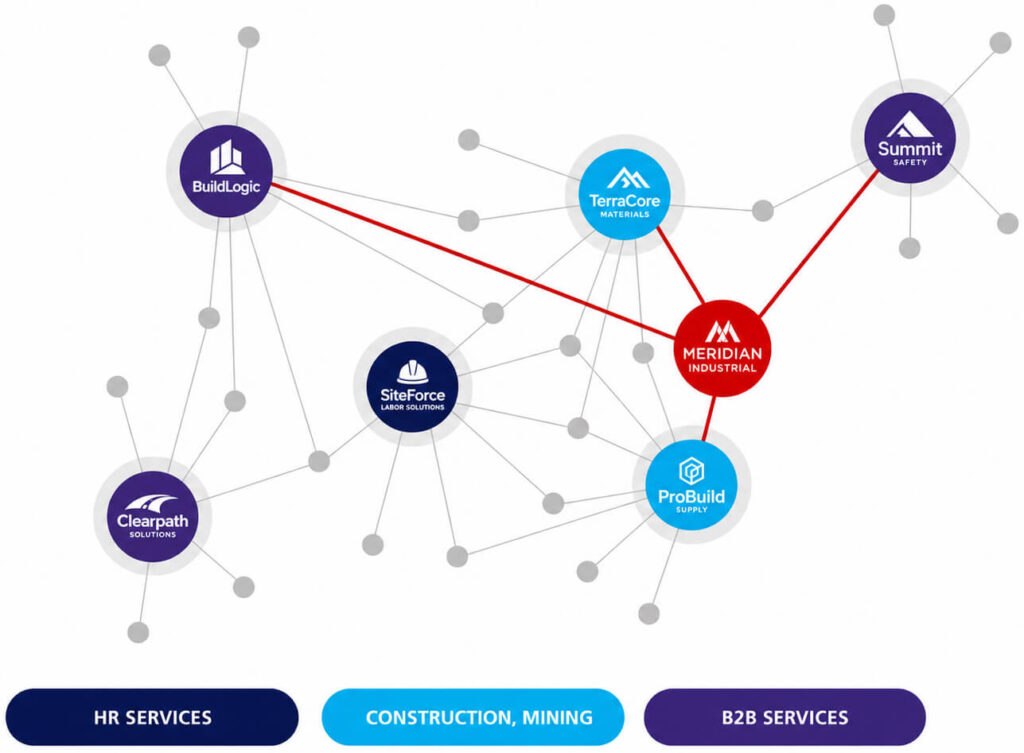
Closing that blind spot is exactly what the Data Lake is designed to do. It sits at the heart of Sidetrade’s AI‑powered O2C Intelligence Platform, aggregating live B2B payment behavior across millions of vendor–buyer relationships. Instead of isolated ledgers, it provides a network‑level view of how buyers actually pay, built from more than 1 billion invoices and around $9 trillion in payment experiences from roughly 45 million buyers worldwide. And it’s not based on static accounting snapshots; it draws on the continuous stream of invoices, payments, disputes, and collections outcomes recorded across the network.
Every signal here runs on anonymized data, one-way hashing, and private cloud infrastructure. The result is collective intelligence without exposing a single customer’s raw data to another. No customer sees a competitor’s invoices or learns which of its rivals a buyer also works with, only how that buyer behaves in aggregate. Every insight surfaced is a derived signal rather than a raw record.
From behavior to predictions
Raw signals only matter once they become a forecast, and a forecast only matters once someone acts on it.
Forecasts built on one company’s payment history alone are only half the picture. The network grounds forecasts in how a buyer such as Meridian behaves across its supplier base, narrowing the gap between what a forecast predicts and what actually clears. That gives finance leadership a steadier and more reliable basis for working capital decisions.
That same network also powers Aimie, Sidetrade’s proprietary conversational AI assistant, and the domain-expert AI models built specifically for order-to-cash. Domain-expert models draw on the Data Lake for accounts receivable risk detection and dispute predictions, while Aimie applies those signals across chat, voice, and text.
Together, they change outcomes across credit, collections, sales, and finance in three concrete ways:
- Earlier risk signals. The Data Lake does not just show how a buyer paid; it senses the moment behavior starts to shift, protecting and accelerating cash along the way. Surge detection flags when a buyer’s activity crosses its normal threshold, often before an internal report catches it. Let’s say Meridian quietly starts disputing invoices with several suppliers at once. Inside any single supplier’s own ledger, that still looks like an isolated exception rather than part of a pattern recorded across the network.
- Buyer payment intelligence. Sidetrade Payment Intelligence (SPi) predicts how many days a buyer will take to pay across every supplier with whom it works. Client SPi scores a single buyer; Consolidated SPi rolls that up across a whole portfolio. Benchmarked against actual Average Days to Pay, the gap reveals where terms or collections efforts have room to improve. SPi catches that gap: Meridian might look reliable against one supplier’s own terms while the score shows it paying far slower elsewhere. That contrast turns collections and credit into buyer-network-informed decisions instead of guesswork.
- Recommendations worth trusting. When a buyer shows a strong enough recurring cadence, Aimie’s Payment Window highlights the days of the month it is most likely to pay. Outreach lands inside that window instead of after it closes, right when a reminder has the best chance of working. Consider Meridian: a reminder sent right after its payment run has passed accomplishes nothing until the next cycle. Because the same network data validates each recommendation, a ranked action arrives with a reason attached rather than a black-box score. And for added security, a collector or credit analyst still signs off before it goes out.
From insight to predictable cash flow
Credit, collections, sales, and forecasting decisions get more predictable with one consistent view of buyer behavior. Fragmented, internally sourced signals cannot deliver that same level of perceptibility. Sidetrade’s Data Lake provides exactly that visibility, and would have caught Meridian’s two accounts as a single risk from the start.
By incorporating these insights into everyday workflows, finance teams shift from chasing surprises to running on predictable, data-driven cash flow. Request a demo now to see how Sidetrade’s SPi, surge detection, and Aimie’s recommendations perform against a real buyer portfolio.
Sergejs Cuhrajs, Product Marketing Manager at Sidetrade
With more than 10 years of experience in B2B SaaS product marketing, Sergejs specializes in turning complex market and product concepts into clear positioning, actionable frameworks, and compelling narratives.
At Sidetrade, he focuses on how AI can support better decision-making, accelerate operational impact, and help finance leaders balance speed, control, governance, and ROI across the O2C cycle.
FAQ
What is Sidetrade's Data Lake?
Sidetrade’s Data Lake is a privacy-governed, real-time repository of B2B payment behavior. It spans more than a billion invoices and roughly $9 trillion in transactions across 45 million+ buyers worldwide. It aggregates anonymized data from every vendor-buyer relationship on the network, turning isolated ledgers into one market-level view of how buyers pay.
How does the Data Lake recognize the same buyer across different suppliers?
The Data Lake continuously matches every buyer record against official company registries and referential data, resolving name variants, addresses, and registration details into a single, globally unique company identity with a confidence score. This lets it recognize when two invoices billed to different-looking accounts belong to the same global buyer.
What is the difference between SPi and Aimie?
Sidetrade Payment Intelligence (SPi) is a predictive score showing how many days a buyer is likely to take to pay. It is benchmarked against that buyer’s actual Average Days to Pay. Aimie, Sidetrade’s proprietary conversational AI assistant, acts on that intelligence, turning SPi’s forecasts and other Data Lake signals into ranked, explainable next-best actions.
How does the Data Lake protect customer data?
Every signal in the Data Lake runs on anonymized data, one-way hashing, and private cloud infrastructure. No customer sees another customer’s invoices or learns which competitors a buyer also works with, and only aggregate, derived signals about buyer behavior are surfaced, never raw records.