
Home » O2C Intelligence Platform » O2C Execution Layer » O2C Apps » Augmented Collection
Augmented Collection
Collections Automation
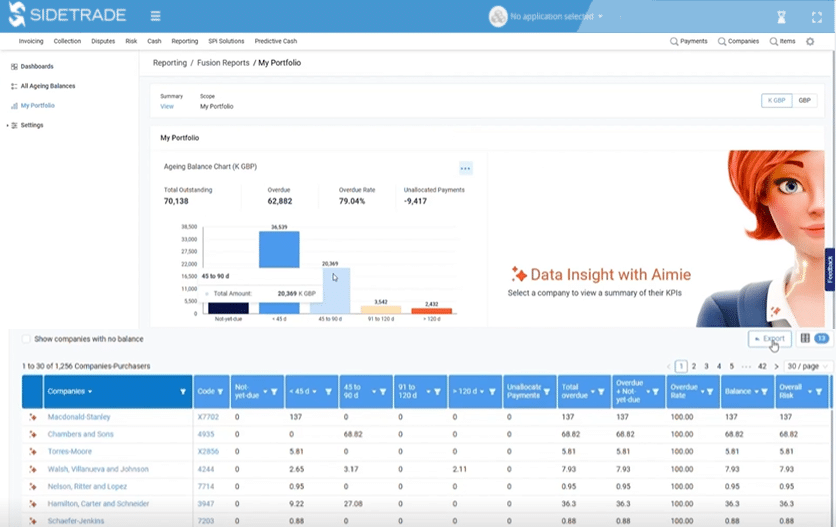
Sidetrade’s AI-guided collections automation app, Augmented Collection, unifies invoice, customer, payment, and behavioral signals to determine the next-best action per invoice, at scale.
AI–driven accounts receivable worklists, automated dunning, and constraint-aware orchestration run the collections process automatically, so teams can focus on high-impact accounts. Business rules and escalation policies maintain consistent governance across every region and entity.
Augmented Collection Solves Your Challenges
Reactive, fragmented collections execution
Static aging reports and disconnected systems leave teams without a unified view of customer behavior, payment signals, or account data.
Aimie AI-Driven Next-Best-Action Dunning unifies O2C signals to determine the right action per invoice.
Collector time consumed by routine outreach
Manual reminders, acknowledgments, and follow-ups absorb time that should go to exceptions and higher-impact accounts.
Event-Based Automation automates routine dunning within configured strategy guardrails, freeing up collectors’ time for higher-impact accounts.
Inconsistent collections execution across teams and regions
Without enforceable constraints, collections approaches vary by entity and individual – this undermines governance and compliance.
Segment-Based Strategy and Action Limits standardize the collections process across the portfolio without removing flexibility for individual teams.


Features
.

Aimie AI-Driven Next-Best-Action Dunning

Intelligent Prioritization
and Daily Collector Agendas

Tailored Dunning with
Business Rules and Constraints

Segment-Based Strategy
and Action Limits

Event-Based Automation for
Routine Messaging and Follow-Up

Multi-Channel Engagement and
Media-Level Performance Insights

Collections Performance
Analytics and Benchmarking

Customer Collaboration
via Customer Portal

Automated Mail / Fax Traceability
with SidePaperless
Why Sidetrade?
Augmented Collection is one of Sidetrade’s order to cash tools, delivering measurable cash impact across collections automation, collector productivity, and operational efficiency.
*based on comparisons across customer platforms since April 2019
How Collections Automation Works
Augmented Collection runs on Sidetrade’s order-to-cash platform, connecting to your ERP, CRM, and billing integrations so collections run on live invoice and payment data, not static reports.
Unify invoice, customer, and payment data
Invoice, customer, and payment data flow in from your ERP and other connected systems into a single view, giving collectors and finance teams one source of truth instead of disconnected spreadsheets.
Prioritize accounts with AI-driven scoring
Aimie scores every account and recommends the next-best collection action, so high-impact accounts and exceptions rise to the top of each collector’s daily agenda.
Automate outreach, route exceptions to the right team
Routine dunning and follow-up run automatically within your business rules, while cases that need judgment are routed to the right collector or credit team for faster resolution.
Frequently Asked Questions
What is collections automation?
Collections automation is the use of AI and rules-based software to manage the accounts receivable collections process: prioritizing which invoices and customers need attention, recommending or executing the next-best action, and orchestrating outreach across channels, with minimal manual effort. Augmented Collection is Sidetrade’s collections automation app, built to run this process at scale across every account, region, and entity.
How is AI-driven collections automation different from traditional dunning?
Traditional dunning works off a fixed schedule and prioritizes invoices by what simply looks oldest. Augmented Collection’s Aimie AI-Driven Next-Best-Action Dunning instead unifies invoice, customer, and behavioral signals to determine the right action, timing, and channel for each invoice based on what is most likely to move cash. These recommendations are generated by Aimie, Sidetrade’s accounts receivable AI agent, purpose-built for autonomous execution across collections, cash application, disputes, and credit.
What happens when a customer disputes an invoice?
Disputed invoices are flagged and routed out of the standard dunning flow, so they are not chased like a normal past due account. Augmented Collection connects to Sidetrade’s invoice dispute management, so the dispute gets resolved by the right team while collectors stay focused on accounts that are actually collectible.
What can be automated in the collections process?
Augmented Collection automates routine dunning, reminders, and follow-up through Event-Based Automation, builds daily prioritized collector agendas, applies tailored dunning rules and segment-based strategies, executes outreach across multiple channels, and traces physical mail and fax communications through SidePaperless. Collectors stay focused on exceptions and high-impact accounts while the routine work runs on its own.
Does collections automation integrate with our ERP and existing systems?
Yes. Augmented Collection runs on Sidetrade’s order to cash software, which connects to your ERP, CRM, and billing systems, so invoice, customer, and payment data stay connected across the systems you already use.
Can customers interact directly with Augmented Collection?
Yes, through Customer Collaboration via Customer Portal. Customers can view invoices, track payment status, and manage communications directly, connecting to Sidetrade’s Customer Experience Center, an accounts receivable customer portal that removes friction from the collection process.
How do we track collections performance over time?
Collections Performance Analytics and Benchmarking is built into Augmented Collection and connects to Sidetrade’s broader accounts receivable analytics, which tracks DSO, CEI, aging balances, dispute rates, and collection effectiveness across the full portfolio.

Ready to Transform Your Order-to-Cash?
Finance transformation with AI is at your fingertips. Are you ready? Join finance leaders already experiencing the power of Aimie. Take the first step towards transforming your order-to-cash operations.